Introduction
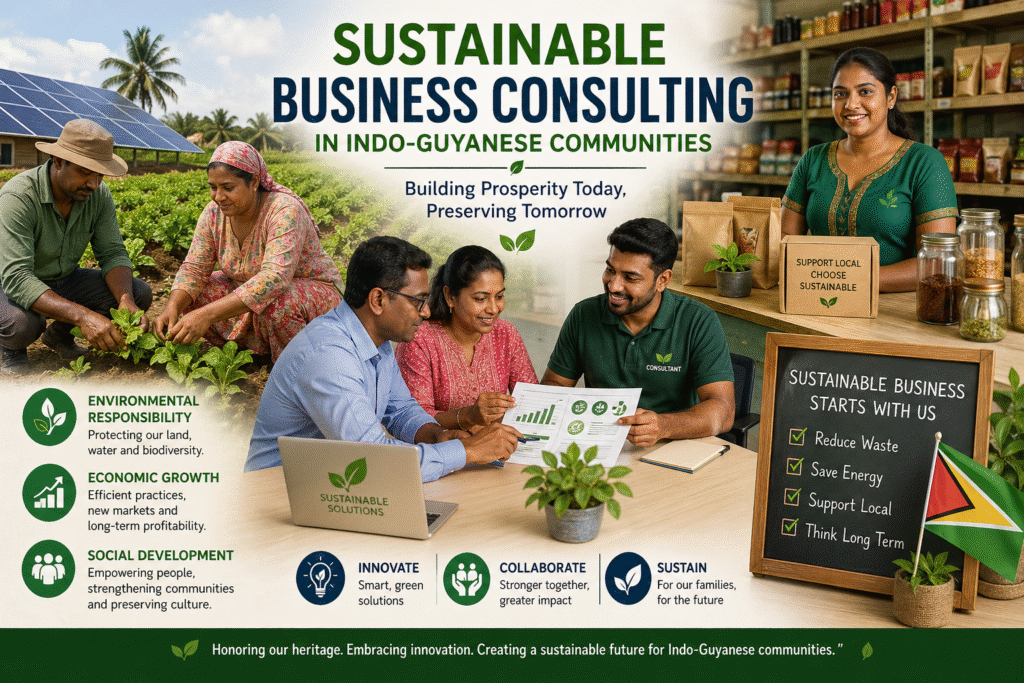
In today’s rapidly evolving global economy, sustainability is no longer just a trend—it is a necessity. Businesses across the world are shifting their focus toward environmentally responsible and socially conscious practices. Likewise, Indo-Guyanese communities are increasingly recognizing the value of sustainable business consulting as a pathway to long-term growth and resilience. By blending cultural heritage with modern sustainability principles, these communities can create businesses that thrive economically while preserving resources for future generations.
Understanding Sustainability in a Community Context
To begin with, sustainability in Indo-Guyanese business environments goes beyond environmental concerns. It also includes economic stability and social well-being. Traditionally, Indo-Guyanese communities have relied on agriculture, small-scale enterprises, and family-run businesses. Therefore, integrating sustainable practices into these sectors can have a profound impact.
Moreover, sustainability consulting helps businesses identify inefficiencies, reduce waste, and adopt eco-friendly alternatives. For instance, agricultural businesses can shift toward organic farming or water conservation techniques. As a result, they not only protect natural resources but also improve product quality and market value.
The Role of Sustainable Business Consultants
Sustainable business consultants play a crucial role in guiding enterprises through this transformation. Initially, they assess current business practices and identify areas for improvement. Subsequently, they design strategies tailored to the specific needs of Indo-Guyanese businesses.
In addition, consultants often provide training and resources to ensure that business owners understand the benefits of sustainability. This is particularly important in communities where awareness of modern sustainable practices may still be developing. Consequently, education becomes a key driver of change.
Furthermore, consultants bridge the gap between traditional knowledge and innovative solutions. For example, they may incorporate age-old farming wisdom with modern renewable energy technologies. In this way, businesses maintain their cultural identity while embracing progress.
Economic Benefits of Sustainability
One of the most compelling reasons to adopt sustainable practices is the potential for economic growth. Although some business owners may initially worry about costs, sustainable consulting often leads to long-term savings. For example, energy-efficient systems reduce electricity expenses, while waste reduction lowers operational costs.
Additionally, sustainable businesses are more attractive to investors and customers. Today’s consumers are increasingly conscious of environmental and ethical issues. Therefore, businesses that demonstrate responsibility are more likely to gain trust and loyalty.
Moreover, sustainable consulting opens doors to international markets. Many global buyers prefer products that meet environmental and ethical standards. As a result, Indo-Guyanese businesses can expand their reach and increase profitability.
Social Impact and Community Development
Beyond financial gains, sustainable business consulting also fosters social development. For instance, it encourages fair labor practices and inclusive growth. When businesses prioritize employee well-being, they create healthier and more productive work environments.
At the same time, sustainable initiatives often involve community participation. Whether it is local sourcing or collaborative projects, these efforts strengthen community bonds. Consequently, businesses become not just profit-making entities but also contributors to social progress.
Furthermore, sustainability promotes intergenerational responsibility. By preserving resources and adopting ethical practices, current business owners ensure that future generations can continue to thrive. This aligns deeply with the values of many Indo-Guyanese families, where legacy and continuity are highly valued.
Environmental Responsibility
Another critical aspect of sustainable consulting is environmental protection. Indo-Guyanese communities, particularly those involved in agriculture, depend heavily on natural resources. Therefore, preserving these resources is essential for long-term survival.
For example, consultants may recommend practices such as crop rotation, renewable energy usage, and waste recycling. In addition, they may introduce eco-friendly packaging solutions for small businesses. As a result, businesses reduce their environmental footprint while enhancing their brand image.
Moreover, environmental responsibility can also lead to innovation. Businesses that adopt green practices often discover new opportunities, such as eco-tourism or organic product lines. Thus, sustainability becomes a catalyst for creativity and growth.
Challenges in Implementation
Despite its many benefits, implementing sustainable business practices is not without challenges. To begin with, there may be a lack of awareness or understanding among business owners. In some cases, traditional methods are deeply ingrained, making change difficult.
Additionally, financial constraints can pose a barrier. Although sustainability leads to long-term savings, the initial investment may be a concern for small businesses. However, with proper guidance and support, these challenges can be overcome.
Another challenge is limited access to resources and technology. In rural areas, businesses may struggle to adopt modern sustainable solutions. Nevertheless, consultants can help by identifying cost-effective and locally available alternatives.
Strategies for Effective Consulting
To address these challenges, sustainable business consultants must adopt a culturally sensitive approach. First and foremost, they should respect and understand the traditions and values of Indo-Guyanese communities. This builds trust and encourages collaboration.
Furthermore, consultants should focus on practical and achievable solutions. Instead of overwhelming businesses with complex strategies, they can introduce gradual changes. For example, starting with energy conservation measures or waste reduction initiatives.
In addition, partnerships play a vital role. Collaborating with local organizations, government bodies, and educational institutions can provide businesses with the necessary support and resources. As a result, sustainability becomes a collective effort rather than an individual burden.
The Future of Sustainable Consulting in Indo-Guyanese Communities
Looking ahead, the future of sustainable business consulting in Indo-Guyanese communities appears promising. As awareness continues to grow, more businesses are likely to embrace sustainable practices. In turn, this will create a ripple effect, inspiring others to follow suit.
Moreover, advancements in technology will make sustainable solutions more accessible and affordable. For instance, renewable energy systems and digital tools can help businesses operate more efficiently. Consequently, sustainability will become an integral part of everyday business operations.
At the same time, younger generations are playing a significant role in driving change. With greater exposure to global trends, they are more inclined to adopt innovative and responsible practices. Therefore, the future of Indo-Guyanese businesses is likely to be both sustainable and dynamic.
Conclusion
In conclusion, sustainable business consulting offers immense potential for Indo-Guyanese communities. By integrating environmental responsibility, economic growth, and social development, businesses can achieve long-term success. Although challenges exist, they can be addressed through education, collaboration, and culturally sensitive strategies.
Ultimately, sustainability is not just about preserving resources—it is about creating a balanced and prosperous future. As Indo-Guyanese businesses continue to evolve, sustainable consulting will play a vital role in shaping their journey. Through thoughtful implementation and community engagement, these businesses can become powerful examples of how tradition and innovation can coexist harmoniously.