
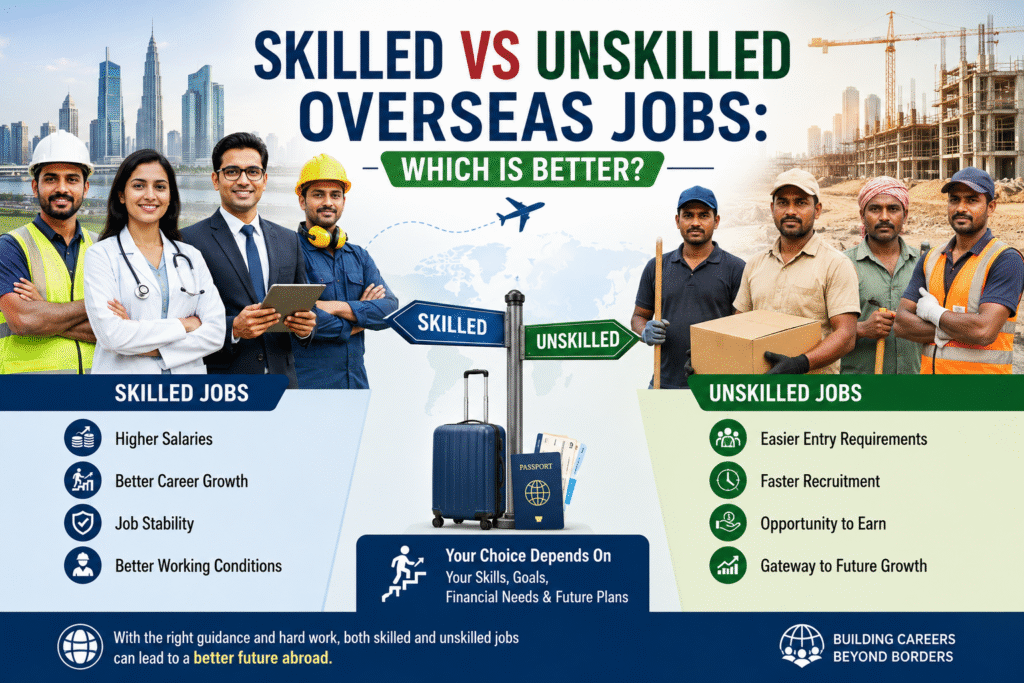
In today’s global employment market, overseas job opportunities are growing rapidly. Countries such as Guyana, Canada, United Arab Emirates, and Qatar continue to attract workers from around the world. As a result, many job seekers often face one important question: Should they choose skilled or unskilled overseas jobs?
Both categories offer unique advantages and challenges. While skilled jobs usually provide higher salaries and long-term career growth, unskilled jobs can offer faster employment opportunities and easier entry requirements. Therefore, understanding the difference between the two is essential before making a life-changing career decision.
This article explores the key differences, benefits, challenges, and future opportunities of skilled and unskilled overseas jobs to help workers choose the right path.
Understanding Skilled Overseas Jobs
Skilled overseas jobs require specialized knowledge, training, certifications, or technical expertise. In most cases, workers need formal education or professional experience to qualify for these positions.
Examples of skilled overseas jobs include:
- Engineers
- Electricians
- Nurses
- Welders
- IT professionals
- Heavy equipment operators
- Accountants
- Construction supervisors
These jobs are highly valued in international markets because industries worldwide are facing shortages of qualified professionals.
Advantages of Skilled Overseas Jobs
1. Higher Salaries
One of the biggest advantages of skilled jobs is better pay. Skilled workers usually earn significantly more compared to unskilled laborers. For example, certified electricians or engineers working abroad often receive competitive salaries, overtime benefits, accommodation support, and insurance coverage.
Furthermore, skilled professionals may receive annual bonuses and opportunities for promotion.
2. Better Career Growth
Skilled overseas jobs often lead to long-term career development. Workers can gain international experience, improve technical expertise, and move into leadership positions over time.
In addition, overseas experience can improve future job opportunities both internationally and in the worker’s home country.
3. Greater Job Stability
Companies investing in skilled employees usually prefer long-term contracts. As a result, skilled workers may enjoy better job security and stable employment conditions.
Moreover, many countries actively encourage skilled migration programs because they need trained professionals for economic growth.
4. Improved Working Conditions
Skilled workers generally work in safer and more organized environments. They may also receive better accommodation, healthcare benefits, paid leave, and legal protections.
Therefore, skilled overseas employment can improve both professional and personal quality of life.
Challenges of Skilled Overseas Jobs
Although skilled jobs offer many benefits, they also come with certain difficulties.
1. Qualification Requirements
Most skilled jobs require certificates, degrees, licenses, or previous work experience. Consequently, some workers may need additional training before applying.
For example, nurses or electricians may need international certification approvals before they can work abroad legally.
2. Competitive Recruitment
Since skilled jobs offer attractive salaries, competition can be intense. Employers often select candidates with strong experience and communication skills.
Therefore, applicants must prepare carefully for interviews and technical assessments.
3. Longer Processing Time
Visa approvals, document verification, and skill assessments may take longer for skilled workers. While the final outcome can be rewarding, the process often requires patience.
Understanding Unskilled Overseas Jobs
Unskilled overseas jobs usually require little or no formal education, technical certification, or professional training. These jobs mainly depend on physical labor and basic practical skills.
Common unskilled overseas jobs include:
- Helpers
- Cleaners
- Farm workers
- Warehouse staff
- Housekeeping workers
- Loaders
- Kitchen assistants
- General laborers
These positions are especially common in construction, agriculture, hospitality, and manufacturing industries.
Advantages of Unskilled Overseas Jobs
1. Easier Entry Requirements
One major advantage of unskilled jobs is accessibility. Many employers hire workers without advanced education or specialized training.
As a result, workers can secure overseas employment more quickly.
2. Faster Recruitment Process
Unskilled jobs often involve simpler hiring procedures. Since qualification checks are limited, recruitment and visa processing may be completed faster.
Therefore, workers seeking immediate income opportunities often prefer unskilled overseas jobs.
3. Opportunity to Earn Better Than Local Wages
Although unskilled overseas jobs may not offer extremely high salaries, workers can still earn more compared to local opportunities in many developing countries.
Additionally, free accommodation and food allowances may help workers save money for their families.
4. Gateway to Future Growth
Many workers begin with unskilled jobs and later learn new skills through experience. Over time, they may move into semi-skilled or skilled roles.
For instance, a construction helper may eventually become a machine operator or site supervisor after gaining experience abroad.
Challenges of Unskilled Overseas Jobs
1. Lower Salaries
Compared to skilled positions, unskilled jobs usually offer lower pay. Income growth may also be slower over time.
Consequently, workers may need to work longer hours to achieve financial goals.
2. Physically Demanding Work
Many unskilled jobs involve heavy labor, long working hours, and physically exhausting tasks. Construction, farming, and warehouse jobs can be especially challenging.
Therefore, workers must maintain good physical health and endurance.
3. Limited Career Advancement
While some workers grow through experience, career progression opportunities may still be limited compared to skilled professions.
As industries become more technology-driven, demand for highly skilled workers continues to increase globally.
Which Is Better?
The answer depends entirely on an individual’s goals, qualifications, financial situation, and career ambitions.
Skilled Jobs Are Better If:
- You have technical qualifications or certifications
- You want long-term career growth
- You are looking for higher salaries
- You prefer professional work environments
- You are willing to invest time in training and documentation
Unskilled Jobs Are Better If:
- You need immediate employment
- You do not have formal qualifications
- You want to gain overseas experience quickly
- You are comfortable with physically demanding work
- You plan to develop skills gradually over time
Ultimately, neither option is universally better. Instead, the best choice depends on the worker’s personal circumstances and future plans.
The Growing Importance of Skills in Global Recruitment
Today, global industries are changing rapidly. Automation, technology, and infrastructure development are increasing demand for trained professionals.
Countries experiencing economic growth, including Guyana, are investing heavily in construction, oil and gas, transportation, and healthcare sectors. Consequently, skilled manpower is becoming increasingly valuable.
However, unskilled labor remains essential for industries that depend on large workforces. Construction sites, factories, farms, and hospitality businesses still rely heavily on general workers.
Therefore, both skilled and unskilled workers continue to play important roles in international labor markets.
How Manpower Consultancies Help Workers
Professional manpower consultancies help job seekers choose suitable overseas opportunities based on their qualifications and goals.
These agencies assist with:
- Job matching
- Visa processing
- Documentation support
- Employer verification
- Interview preparation
- Travel arrangements
- Pre-departure guidance
Moreover, reliable consultancies help workers avoid scams and illegal recruitment practices.
For this reason, choosing a trusted manpower consultancy is extremely important when applying for overseas jobs.
Conclusion
Skilled and unskilled overseas jobs each offer valuable opportunities for workers seeking better financial stability and career growth. Skilled jobs generally provide higher salaries, professional advancement, and long-term stability. On the other hand, unskilled jobs offer easier entry, quicker hiring, and immediate earning opportunities.
Instead of asking which option is universally better, workers should evaluate their own abilities, goals, and readiness for international employment. In many cases, unskilled jobs can become stepping stones toward skilled careers through experience and training.
As global recruitment continues to expand, overseas employment will remain an important pathway for individuals seeking brighter futures. With the right preparation, guidance, and determination, both skilled and unskilled workers can achieve success abroad.