
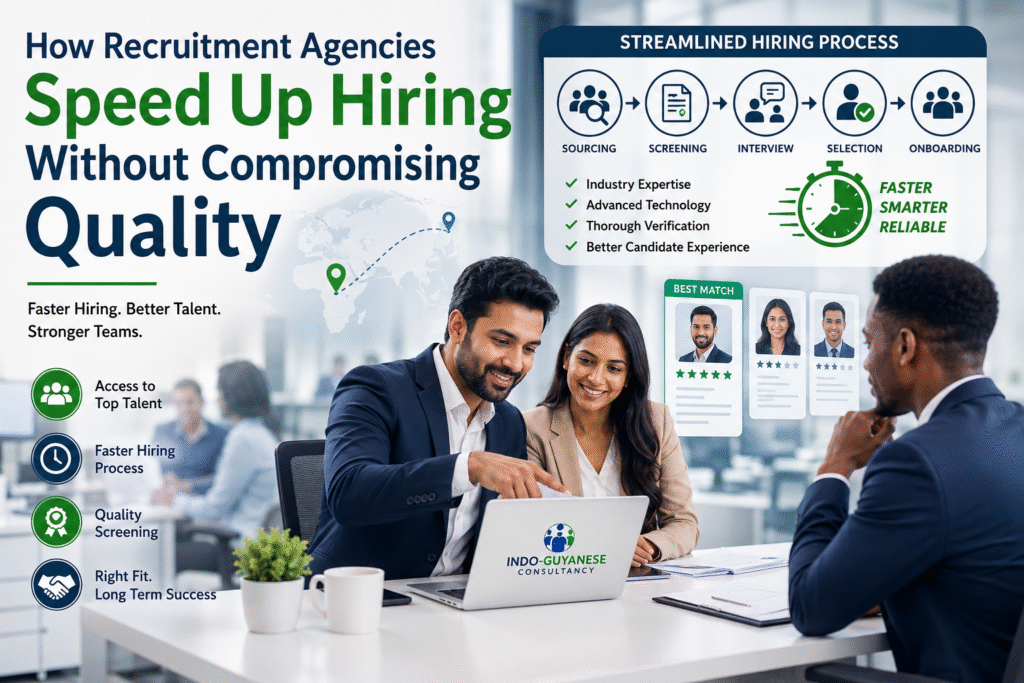
Hiring the right employees is one of the most important responsibilities for any business. Whether a company is expanding, replacing key staff, or filling specialized positions, finding qualified candidates quickly can be challenging. Unfortunately, a lengthy hiring process often leads to lost productivity, increased costs, and missed business opportunities. At the same time, rushing recruitment can result in poor hiring decisions that affect long-term success.
This is where recruitment agencies make a significant difference. By combining industry expertise, extensive talent networks, and proven hiring strategies, they help businesses fill vacancies faster without sacrificing the quality of candidates. As a result, organizations can maintain productivity while building stronger teams.
Understanding the Hiring Challenge
Recruitment today is more competitive than ever. Businesses are not only competing for customers but also for skilled professionals. Furthermore, job seekers have more opportunities, making it essential for employers to move efficiently during the hiring process.
Many organizations struggle with challenges such as:
- A shortage of qualified candidates
- High volumes of applications
- Time-consuming resume screening
- Lengthy interview processes
- Difficulty verifying candidate qualifications
- Increased hiring costs
Consequently, internal HR teams may become overwhelmed, especially when managing multiple vacancies simultaneously.
Why Hiring Speed Matters
Every vacant position affects business performance. For instance, when important roles remain unfilled, existing employees often take on additional responsibilities. This can lead to burnout, reduced efficiency, and lower employee morale.
Moreover, top candidates rarely stay available for long. In many industries, skilled professionals receive multiple job offers within days. Therefore, companies that delay hiring often lose exceptional candidates to competitors.
Recruitment agencies understand this urgency. Accordingly, they streamline every stage of the hiring process while maintaining high recruitment standards.
Access to Ready-to-Hire Talent Pools
One of the biggest advantages of recruitment agencies is their extensive database of qualified professionals. Instead of starting each search from scratch, agencies maintain relationships with active and passive job seekers across various industries.
Additionally, they continuously update candidate profiles, making it easier to identify suitable applicants immediately.
Because of this ready-made talent pool, agencies can:
- Shortlist candidates faster
- Reduce advertising time
- Fill urgent vacancies efficiently
- Match specialized skills with employer requirements
As a result, businesses spend less time searching and more time interviewing highly qualified candidates.
Efficient Candidate Screening
Speed should never come at the expense of quality. Fortunately, professional recruitment agencies have structured screening processes that eliminate unsuitable candidates before they reach employers.
Typically, agencies evaluate:
- Professional experience
- Technical skills
- Educational qualifications
- Communication abilities
- Career goals
- Cultural compatibility
Furthermore, many agencies conduct preliminary interviews, reference checks, and document verification before presenting candidates.
Consequently, employers only interview individuals who genuinely meet the job requirements.
Industry Expertise Improves Hiring Accuracy
Different industries require different recruitment strategies. For example, hiring engineers requires different evaluation methods than hiring healthcare professionals or hospitality staff.
Recruitment agencies often specialize in particular industries, allowing recruiters to understand:
- Current market trends
- Required certifications
- Salary expectations
- Industry-specific skills
- Employer expectations
Because recruiters understand these factors, they can identify qualified candidates much faster than general hiring teams.
Moreover, their expertise helps prevent costly hiring mistakes.
Advanced Recruitment Technology
Modern recruitment agencies leverage technology to increase efficiency while maintaining accuracy.
For example, they use:
- Applicant Tracking Systems (ATS)
- AI-powered resume screening
- Skills assessment tools
- Video interviewing platforms
- Digital document management
- Recruitment analytics
These technologies automate repetitive tasks, allowing recruiters to focus on evaluating candidate quality rather than administrative work.
Furthermore, technology reduces human error and improves hiring consistency.
Better Job Matching
Successful hiring is about more than matching technical skills. Employees also need to fit the company’s culture, values, and long-term objectives.
Recruitment agencies spend time understanding both employers and candidates.
They consider factors such as:
- Workplace culture
- Leadership style
- Career ambitions
- Team dynamics
- Communication preferences
As a result, candidates are more likely to succeed and remain with the company for longer periods.
Therefore, businesses benefit from improved employee retention and reduced turnover.
Faster Interview Coordination
Scheduling interviews often delays the hiring process. Recruitment agencies simplify this stage by coordinating communication between employers and candidates.
They manage:
- Interview scheduling
- Candidate confirmations
- Follow-up communication
- Feedback collection
- Offer negotiations
Consequently, hiring managers spend less time on administrative tasks and more time evaluating potential employees.
This organized approach keeps recruitment moving efficiently.
Reducing Hiring Risks
Poor hiring decisions can be expensive. Beyond recruitment costs, businesses may face reduced productivity, additional training expenses, and repeated recruitment efforts.
Recruitment agencies minimize these risks through comprehensive evaluation procedures.
These often include:
- Employment verification
- Background checks
- Reference validation
- Skills assessments
- Qualification confirmation
As a result, employers gain greater confidence in their hiring decisions.
Furthermore, many recruitment agencies offer replacement guarantees, providing additional peace of mind if a candidate does not meet expectations.
Supporting Employers During High-Volume Recruitment
Certain industries regularly require large numbers of employees within short timeframes. Construction projects, manufacturing facilities, hospitality businesses, and seasonal employers often experience rapid hiring demands.
Recruitment agencies have the resources to manage high-volume recruitment efficiently.
They can simultaneously:
- Source candidates
- Conduct interviews
- Verify documentation
- Coordinate onboarding
- Maintain hiring quality
Therefore, businesses can expand operations without overwhelming their internal HR departments.
Improving the Candidate Experience
A positive candidate experience also contributes to faster hiring.
Recruitment agencies maintain regular communication throughout the hiring process by:
- Providing application updates
- Preparing candidates for interviews
- Answering employment questions
- Explaining job expectations
- Offering career guidance
Because candidates feel informed and supported, they are more likely to remain engaged throughout the recruitment process.
Consequently, businesses experience fewer candidate withdrawals and higher offer acceptance rates.
Cost Savings Alongside Faster Hiring
Although some businesses hesitate to use recruitment agencies because of service fees, professional recruitment often reduces overall hiring costs.
For example, agencies help organizations save money by:
- Reducing vacancy duration
- Lowering advertising expenses
- Preventing poor hiring decisions
- Improving employee retention
- Minimizing recruitment administration
Therefore, businesses often achieve a stronger return on investment despite the agency’s recruitment fees.
Building Long-Term Recruitment Partnerships
The most successful companies view recruitment agencies as long-term business partners rather than temporary service providers.
Over time, recruiters develop a deeper understanding of the company’s:
- Business objectives
- Company culture
- Hiring preferences
- Growth plans
- Workforce needs
As a result, future recruitment becomes even faster and more accurate.
Additionally, long-term partnerships create consistency in hiring quality while reducing recruitment effort.
Why Quality Should Always Come First
While speed is important, quality remains essential. Hiring the wrong employee simply to fill a vacancy can create far greater problems in the future.
Professional recruitment agencies understand this balance. Rather than rushing recruitment, they optimize each stage of the hiring process to eliminate unnecessary delays while maintaining careful candidate evaluation.
Consequently, employers receive qualified professionals who can contribute immediately and remain valuable members of the organization.
Conclusion
In today’s competitive employment market, businesses cannot afford slow hiring processes or poor recruitment decisions. Recruitment agencies provide the perfect balance between speed and quality by leveraging extensive talent networks, industry expertise, advanced technology, and structured screening methods.
Moreover, they simplify every stage of recruitment—from sourcing candidates to coordinating interviews and verifying qualifications—allowing employers to focus on growing their businesses.
Ultimately, partnering with a professional recruitment agency enables companies to fill positions quickly, reduce hiring risks, improve employee retention, and build stronger teams for long-term success. By accelerating recruitment without compromising quality, agencies become valuable strategic partners that help organizations remain competitive in an ever-changing workforce landscape.