
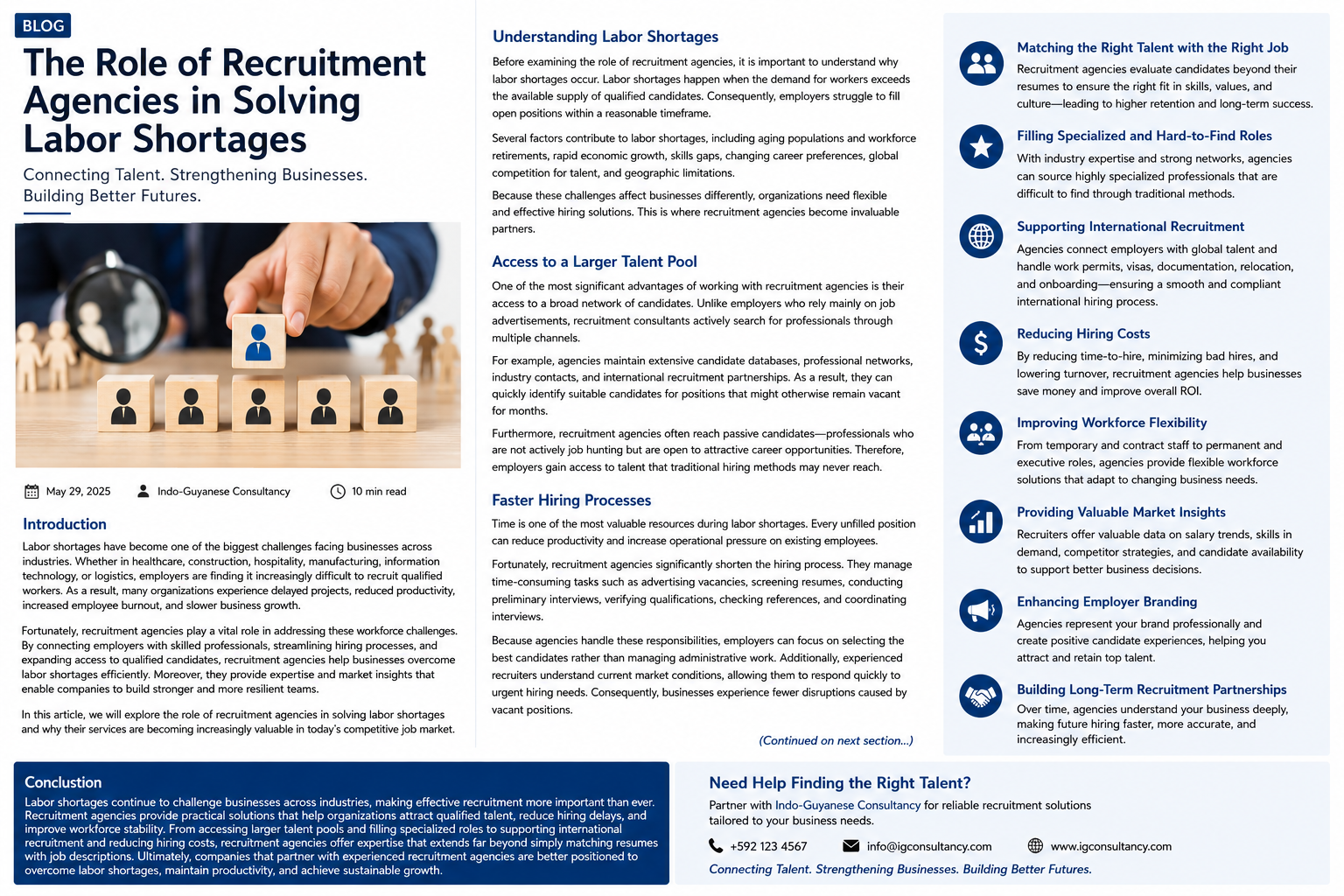
Labor shortages have become one of the biggest challenges facing businesses across industries. Whether in healthcare, construction, hospitality, manufacturing, information technology, or logistics, employers are finding it increasingly difficult to recruit qualified workers. As a result, many organizations experience delayed projects, reduced productivity, increased employee burnout, and slower business growth.
Fortunately, recruitment agencies play a vital role in addressing these workforce challenges. By connecting employers with skilled professionals, streamlining hiring processes, and expanding access to qualified candidates, recruitment agencies help businesses overcome labor shortages efficiently. Moreover, they provide expertise and market insights that enable companies to build stronger and more resilient teams.
In this article, we will explore the role of recruitment agencies in solving labor shortages and why their services are becoming increasingly valuable in today’s competitive job market.
Understanding Labor Shortages
Before examining the role of recruitment agencies, it is important to understand why labor shortages occur. Labor shortages happen when the demand for workers exceeds the available supply of qualified candidates. Consequently, employers struggle to fill open positions within a reasonable timeframe.
Several factors contribute to labor shortages, including:
- Aging populations and workforce retirements
- Rapid economic growth creating new job opportunities
- Skills gaps between available workers and employer needs
- Changing career preferences among younger generations
- Increased global competition for skilled professionals
- Geographic limitations in local labor markets
Because these challenges affect businesses differently, organizations need flexible and effective hiring solutions. This is where recruitment agencies become invaluable partners.
Access to a Larger Talent Pool
One of the most significant advantages of working with recruitment agencies is their access to a broad network of candidates. Unlike employers who rely mainly on job advertisements, recruitment consultants actively search for professionals through multiple channels.
For example, agencies maintain extensive candidate databases, professional networks, industry contacts, and international recruitment partnerships. As a result, they can quickly identify suitable candidates for positions that might otherwise remain vacant for months.
Furthermore, recruitment agencies often reach passive candidates—professionals who are not actively job hunting but are open to attractive career opportunities. Therefore, employers gain access to talent that traditional hiring methods may never reach.
Faster Hiring Processes
Time is one of the most valuable resources during labor shortages. Every unfilled position can reduce productivity and increase operational pressure on existing employees.
Fortunately, recruitment agencies significantly shorten the hiring process. They manage time-consuming tasks such as:
- Advertising vacancies
- Screening resumes
- Conducting preliminary interviews
- Verifying qualifications
- Checking references
- Coordinating interviews
Because agencies handle these responsibilities, employers can focus on selecting the best candidates rather than managing administrative work.
Additionally, experienced recruiters understand current market conditions, allowing them to respond quickly to urgent hiring needs. Consequently, businesses experience fewer disruptions caused by vacant positions.
Matching the Right Talent with the Right Job
Hiring quickly is important, but hiring the right employee is even more critical.
Recruitment agencies specialize in evaluating candidates beyond their resumes. In addition to reviewing technical qualifications, recruiters assess communication skills, work ethic, adaptability, cultural fit, and long-term career goals.
As a result, employers receive candidates who not only meet job requirements but also align with company values and workplace culture.
This careful matching process reduces employee turnover and improves long-term retention. Therefore, businesses benefit from greater workforce stability while minimizing the costs associated with repeated hiring.
Filling Specialized and Hard-to-Find Roles
Many industries require professionals with highly specialized skills. Unfortunately, these candidates are often difficult to locate through traditional recruitment methods.
Recruitment agencies possess industry-specific expertise that allows them to identify qualified professionals more effectively. Whether businesses require engineers, healthcare professionals, IT specialists, accountants, or skilled tradespeople, experienced recruiters understand where to find the right talent.
Moreover, agencies continuously monitor labor market trends and maintain relationships with professionals in specialized industries. Consequently, employers gain access to candidates who possess the precise qualifications needed for complex roles.
Supporting International Recruitment
In many countries, local labor markets cannot fully meet employer demand. Therefore, international recruitment has become an essential strategy for addressing workforce shortages.
Recruitment agencies play an important role by connecting employers with qualified candidates from different countries while ensuring compliance with immigration and employment regulations.
Additionally, they assist with:
- Work permit guidance
- Visa documentation
- Credential verification
- Relocation support
- Candidate onboarding
Because of this comprehensive support, businesses can confidently expand their search beyond domestic labor markets while reducing administrative burdens.
Reducing Hiring Costs
Although some businesses hesitate to use recruitment agencies due to service fees, professional recruitment often reduces overall hiring costs.
Poor hiring decisions can be extremely expensive. Recruiting the wrong employee may result in repeated advertising costs, additional training expenses, lower productivity, and increased turnover.
Recruitment agencies help minimize these risks by presenting carefully screened candidates who are more likely to succeed in their roles.
Furthermore, faster hiring reduces overtime costs, temporary staffing expenses, and lost productivity caused by vacant positions. Therefore, recruitment services often provide an excellent return on investment.
Improving Workforce Flexibility
Business demands frequently change throughout the year. For instance, seasonal industries experience significant fluctuations in staffing needs.
Recruitment agencies provide flexible workforce solutions by supplying:
- Temporary employees
- Contract workers
- Permanent staff
- Project-based professionals
- Executive recruitment
As a result, businesses can quickly adapt to changing market conditions without overextending internal hiring resources.
This flexibility enables organizations to remain competitive while maintaining operational efficiency.
Providing Valuable Market Insights
Recruitment agencies do much more than fill vacancies. They also provide valuable labor market intelligence that helps businesses make informed hiring decisions.
Experienced recruiters offer insights into:
- Salary expectations
- Hiring trends
- Skills in demand
- Competitor recruitment strategies
- Candidate availability
- Workforce planning
Consequently, employers can adjust their recruitment strategies based on current market conditions rather than relying on outdated assumptions.
This information supports long-term workforce planning and strengthens overall business performance.
Enhancing Employer Branding
Today’s job seekers carefully evaluate potential employers before accepting job offers.
Recruitment agencies help businesses present themselves professionally throughout the hiring process. They communicate company values, workplace culture, career development opportunities, and employee benefits to prospective candidates.
Additionally, recruiters ensure that candidates have a positive recruitment experience through timely communication and professional guidance.
As a result, organizations strengthen their employer brand and become more attractive to high-quality professionals.
Building Long-Term Recruitment Partnerships
Rather than serving as one-time hiring providers, many recruitment agencies develop long-term partnerships with businesses.
Over time, recruiters gain a deeper understanding of each organization’s culture, hiring preferences, business goals, and workforce requirements.
Consequently, future recruitment becomes faster, more accurate, and increasingly efficient.
These ongoing relationships allow businesses to proactively prepare for workforce changes instead of reacting only when vacancies arise.
Conclusion
Labor shortages continue to challenge businesses across industries, making effective recruitment more important than ever. Fortunately, recruitment agencies provide practical solutions that help organizations attract qualified talent, reduce hiring delays, and improve workforce stability.
From accessing larger talent pools and filling specialized roles to supporting international recruitment and reducing hiring costs, recruitment agencies offer expertise that extends far beyond simply matching resumes with job descriptions. Additionally, their market knowledge, screening capabilities, and long-term recruitment strategies enable businesses to remain competitive in an evolving employment landscape.
Ultimately, companies that partner with experienced recruitment agencies are better positioned to overcome labor shortages, maintain productivity, and achieve sustainable growth. As workforce demands continue to evolve, recruitment agencies will remain essential partners in building resilient, skilled, and successful organizations.