Finding the right employees is one of the most important decisions any business can make. Likewise, job seekers often face a similar challenge when choosing the best path to secure employment. In today’s competitive job market, organizations generally use two primary recruitment methods: recruitment agencies and direct hiring. While both approaches have their advantages and disadvantages, the best choice often depends on the specific needs of employers and candidates.
In this article, we will compare recruitment agencies and direct hiring, explore their benefits and challenges, and help businesses determine which option is better for their hiring goals.
Understanding Recruitment Agencies
A recruitment agency acts as an intermediary between employers and job seekers. These agencies specialize in sourcing, screening, and recommending qualified candidates for various positions. Furthermore, they often maintain extensive databases of potential employees and have access to a broad professional network.
Recruitment agencies can handle different types of hiring needs, including temporary staffing, contract positions, permanent placements, and international recruitment.
Benefits of Using a Recruitment Agency
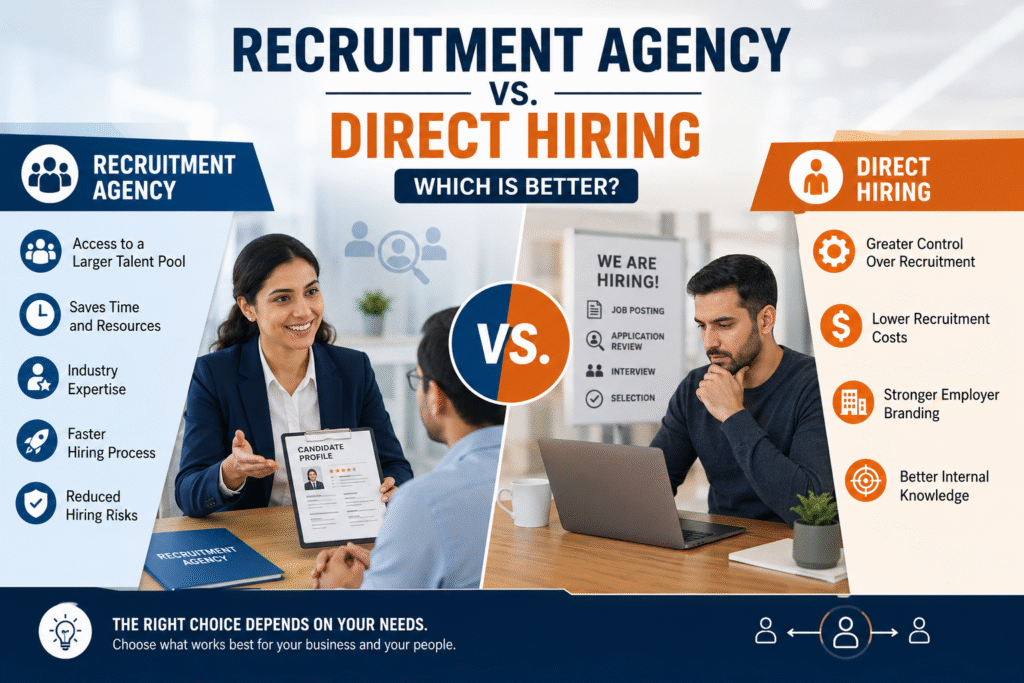
1. Access to a Larger Talent Pool
One of the biggest advantages of working with a recruitment agency is access to a wider range of candidates. In addition, agencies often have connections with passive job seekers who may not actively apply through traditional job postings.
As a result, employers can find highly qualified candidates more quickly.
2. Saves Time and Resources
Hiring can be a lengthy process. From advertising vacancies to reviewing resumes and conducting interviews, recruitment requires significant effort.
However, recruitment agencies handle many of these responsibilities on behalf of employers. Consequently, companies can focus on their core business operations while professionals manage the hiring process.
3. Industry Expertise
Many recruitment agencies specialize in specific industries such as healthcare, construction, information technology, engineering, or hospitality.
Therefore, they understand industry requirements and can identify candidates with the necessary qualifications and experience.
4. Faster Hiring Process
Since agencies already have pre-screened candidates available, vacancies can often be filled more quickly. Moreover, this speed can be particularly valuable when businesses face urgent staffing needs.
5. Reduced Hiring Risks
Recruitment agencies often conduct background checks, reference verification, and skills assessments before recommending candidates.
As a result, employers gain greater confidence in their hiring decisions.
Challenges of Recruitment Agencies
While recruitment agencies offer many benefits, they also have certain limitations.
1. Additional Costs
Recruitment agencies charge placement fees or service fees. Consequently, hiring through an agency may be more expensive than handling recruitment internally.
However, many organizations view these costs as an investment that saves time and reduces hiring mistakes.
2. Less Direct Control
When using an agency, employers may have less direct involvement in the initial stages of candidate screening.
Although agencies work closely with clients, some companies prefer to personally oversee every aspect of recruitment.
3. Potential Communication Gaps
Sometimes information can be misunderstood when passed through a third party. Therefore, maintaining clear communication between the employer and agency is essential.
Understanding Direct Hiring
Direct hiring occurs when employers recruit candidates without involving an external recruitment agency. Instead, organizations advertise positions, review applications, conduct interviews, and manage the entire hiring process internally.
This method is commonly used by businesses with dedicated human resources departments.
Benefits of Direct Hiring
1. Greater Control Over Recruitment
With direct hiring, employers maintain complete control throughout the recruitment process. Furthermore, they can directly assess candidates according to company culture and organizational goals.
As a result, businesses may feel more confident about their final hiring decisions.
2. Lower Recruitment Costs
Since no agency fees are involved, direct hiring can appear more cost-effective initially.
Therefore, smaller businesses with limited budgets often choose this approach.
3. Stronger Employer Branding
Direct interaction allows organizations to present their company culture, values, and work environment more effectively.
Moreover, candidates gain a better understanding of the company from the beginning.
4. Better Internal Knowledge
Internal HR teams understand company needs better than external agencies.
Consequently, they can focus on identifying candidates who align closely with organizational objectives.
Challenges of Direct Hiring
Despite its advantages, direct hiring also presents several challenges.
1. Time-Consuming Process
Recruitment requires advertising jobs, screening applications, scheduling interviews, and conducting evaluations.
As a result, the process can consume substantial time and resources.
2. Limited Candidate Reach
Companies relying solely on direct hiring may only attract active job seekers.
In contrast, recruitment agencies often have access to passive candidates who are not actively searching for jobs but may be open to opportunities.
3. Increased Workload
Managing recruitment internally places additional pressure on HR teams.
Furthermore, during periods of rapid growth, internal departments may struggle to handle multiple vacancies efficiently.
4. Risk of Poor Hiring Decisions
Without extensive screening tools and industry expertise, employers may occasionally hire candidates who are not the best fit.
Consequently, turnover rates and recruitment costs can increase over time.
Recruitment Agency vs. Direct Hiring: Key Comparison
Speed
Recruitment agencies generally provide faster hiring solutions because they already have candidate databases and recruitment networks.
On the other hand, direct hiring often requires more time to attract and evaluate applicants.
Cost
Direct hiring usually involves lower upfront costs. However, recruitment agencies may reduce long-term costs by minimizing hiring errors and shortening vacancy periods.
Candidate Quality
Both methods can produce excellent hires. Nevertheless, recruitment agencies often have access to a broader talent pool and specialized screening techniques.
Control
Direct hiring offers greater control throughout the recruitment process.
Conversely, agency recruitment delegates some responsibilities to external experts.
Flexibility
Recruitment agencies provide flexibility for temporary, contract, seasonal, and international staffing needs.
Meanwhile, direct hiring may be better suited for permanent positions within stable organizations.
Which Option Is Better?
The answer depends on the organization’s specific requirements.
For example, businesses with urgent staffing needs, limited HR resources, or specialized hiring requirements often benefit from working with recruitment agencies. Additionally, companies expanding internationally can gain valuable support from agencies familiar with overseas recruitment regulations.
On the other hand, organizations with experienced HR teams and sufficient recruitment resources may prefer direct hiring. Similarly, businesses seeking complete control over candidate selection may find direct recruitment more suitable.
In many cases, companies successfully combine both approaches. For instance, they may use direct hiring for routine positions while partnering with recruitment agencies for specialized or hard-to-fill roles.
Conclusion
Both recruitment agencies and direct hiring offer unique advantages and challenges. While recruitment agencies provide access to larger talent pools, faster hiring, and professional expertise, direct hiring offers greater control and potentially lower upfront costs.
Ultimately, the best approach depends on factors such as budget, hiring urgency, internal resources, and workforce requirements. Therefore, businesses should carefully evaluate their recruitment goals before choosing a strategy.
By understanding the strengths and limitations of each method, employers can make informed decisions that support long-term organizational growth and success. Whether through a recruitment agency, direct hiring, or a combination of both, the key is finding the right talent to drive the business forward.